Aquifer tests are an essential part of the District's permitting process. The Board and staff rely heavily on results of these tests to inform permit volumes and conditions.
In the spring, Electro Purification (EP) submitted a test well application to allow them to perform an aquifer test on three wells. District staff worked with EP to design and plan an aquifer test that meets District guidelines. The aquifer test will measure responses to abbreviated pumping simulations from the target pumping zone (Middle Trinity--Cow Creek Formation) in surrounding Upper, Middle, and Lower Trinity wells (generalized stratigraphic column showing aquifers and associated formations). The aquifer test is a collaborative effort between the District and EP and will take two to three months to complete.
Synopsis of aquifer test activities:
EP contractors will convert the Odell 1 well into a Lower Glen Rose monitor well. They will plug the bottom portion of the well to seal off the Cow Creek formation, so water level monitoring in the Middle Trinity above the target pumping zone can be monitored. Then EP contractors will develop and install temporary well completions in the three test wells that allow pumping to be isolated to the target pumping zone. They will develop and test Bridges 1 then move to Bridges 2, then Odell 2. During the development and testing, EP contractors and District staff will be sampling water quality and water levels. EP contractors are responsible for monitoring/sampling wells on EP leases. District staff are coordinating with surrounding well owners to monitor/sample additional monitor well sites. As agreed with EP, District staff will be at the well site to observe key well development and testing activities.
In anticipation of community interest and information requests and to make the aquifer test more transparent to the groundwater community, the District (with EP's support) has created a Permit Notice: EP Aquifer Test web page with the following the following information:
|
Thursday, October 27, 2016
EP Aquifer Test Approved


Monday, September 26, 2016
Fall Has Arrived! La Niña too?
Lovelady well height: 545.51 ft-msl (107.91 ft- Depth to Water)
Barton Springs: approxamately 113 cfs 10-day average
Fall 2016 has arrived and hopefully it will
soon bring with it some much-desired cooler temperatures. However, one thing it
may not be bringing is a La Nina. What will that mean for the coming
fall and winter?
We’re all well-familiar with El Niño
after an extremely strong occurrence of the phenomenon brought unusually high
rainfall totals throughout the spring and summer of this year (48.3 inches thus
far in 2106).El Niño occurs when there are unusually high sea surface
temperatures in the Pacific. Conversely, La Niña happens when there are
unusually low sea surface temperatures. In Central Texas, El Niño brings
unusually high rainfall in spring and summer, while La Niña brings rainfall in
the fall and winter. For more information on both La Niña and El Niño, take a
look at this page created by the Pacific Marine Environmental
Library, part of NOAA.
Although surface water temperatures in the
Pacific have been cooling since the peaks of El Niño, they are not decreasing
at the rate climatologists had previously predicted. According to Reuters,
U.S. government forecasters have decreased their prediction of a La Niña
occurring from a probability of 76 percent (put forth in May) to just 36
percent. This month, NOAA officially dropped its “La Niña Watch,” in place
since April.
All
indicators are pointing to a no-Niña winter. That likely means it will also be
a dry one. Regardless, fall greetings to all from BSEACD.
Wednesday, September 14, 2016
2016 Hyro Geo Workshop! (Sept. 30th - Oct. 2nd)
Come spend the weekend with BSEACD, the Edwards Aquifer Authority and many others in real-world field settings, gaining valuable hands-on experience at the 2016 Hydro Geo Workshop September 30th through October 2nd.
The Texas Hydro-Geo Workshop is centered on the collection, processing, analysis and evaluation of hydrologic and geologic field data. It serves as an excellent introduction for aspiring geology, hydrology, and environmental science students, as well as a refresher for seasoned professionals.
The Workshop was created to bring students and professionals together in a field setting for a hands-on learning experience. This is a special opportunity to work with leading researchers and practitioners from across the state and nation. Participants have the opportunity to explore many different techniques for collecting data from soil, rock, and water media. This includes drilling rigs, surface and borehole geophysics, stream gauging, water quality instruments and more.
Participants can select from the various modules depending upon availability. Please note that participation may be limited in some modules for safety reasons, to maintain a high participant/coordinator ratio, or for resource protection.
The Workshop will take place at and around Cave Without a Name near Boerne, Texas. Most activities will be centered at the campsite and pavilion.
Register here soon as there are only about 100 tickets left!
Registration is $60.00 and ends Sept. 30th.
Friday, September 2, 2016
September 6th, National Protect Your Groundwater Day!
Lovelady well height: 544.45 ft-msl (108.97 ft- Depth to Water)
Barton Springs: approxamately 114 cfs 10-day average
The National
Groundwater Association's National Protect Your Groundwater Day helps focus
attention on how important groundwater is as a shared resource and encourages
everyone to do their part to help protect groundwater resources. The
District agrees!
Everyone can and should do something to
protect groundwater. Why? We all have a stake in maintaining its quality and
quantity. Here are a few statistics and details from the National
Groundwater Association...
- For starters, 99 percent of all available freshwater comes from aquifers underground. Being a good steward of groundwater just makes sense.
- Not only that, most surface water bodies are connected to groundwater so how you impact groundwater matters.
- Furthermore, many public water systems draw all or part of their supply from groundwater, so protecting the resource protects the public water supply and impacts treatment costs.
- If you own a well to provide water for your family, farm, or business, groundwater protection is doubly important. As a well owner, you are the manager of your own water system. Protecting groundwater will help reduce risks to your water supply.
For more information about local
groundwater resources, tips and tricks for well maintenance, water quality
information, treatment options, and other well owner resources, check out the District's
Well Owner Guide.
Monday, August 8, 2016
Edwards & Trinity Water Levels Declining
Lovelady well height: 542.87 ft-msl (110.55 ft-Depth to Water)
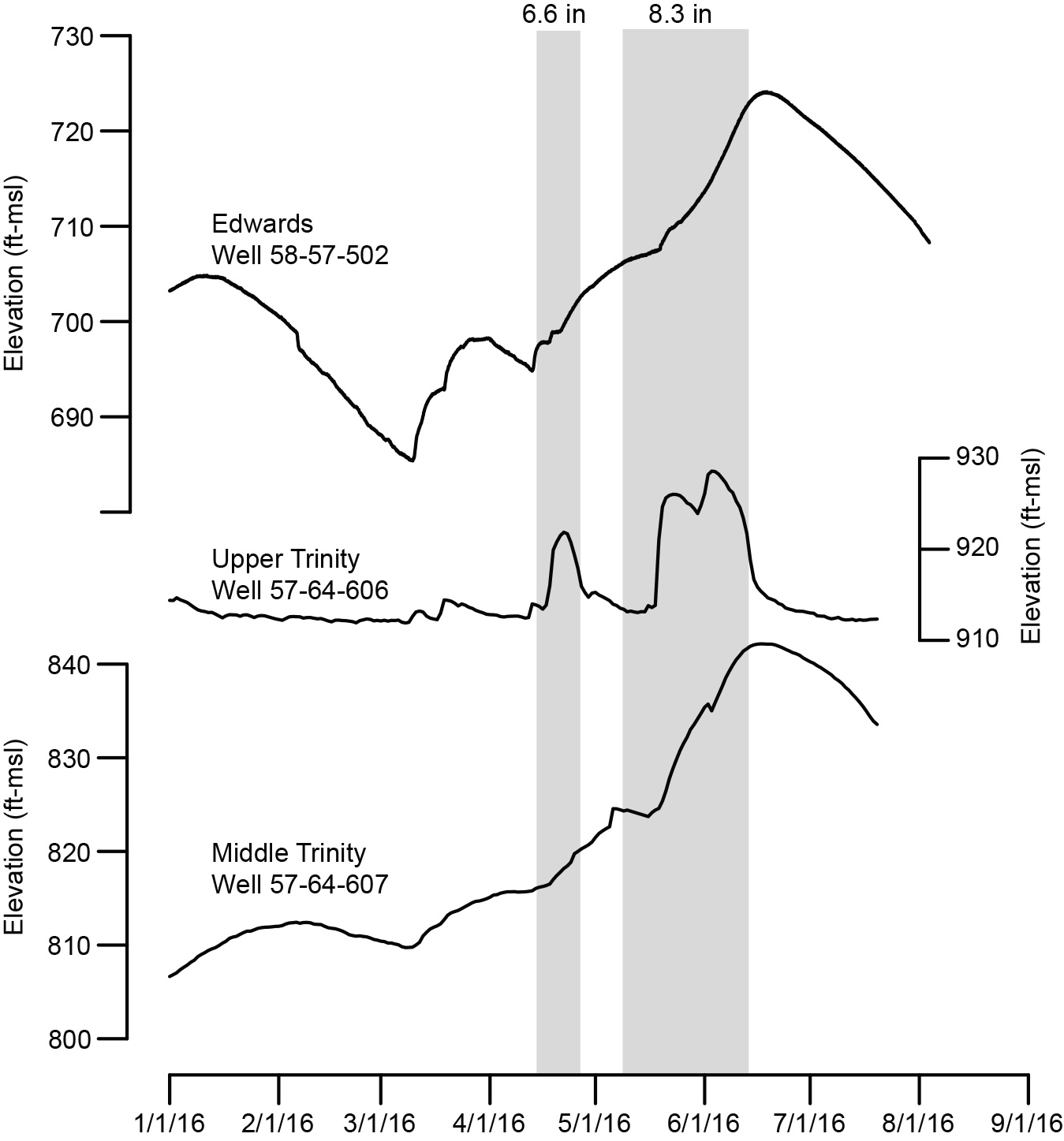
Barton Springs: approximately 109 cfs 10-day averageCentral Texas enters August with none of the area in drought conditions. This is directly the result of the wet winter and spring of 2015-2016 leading to some near-historic rainfall totals and high surface-water and groundwater levels. Groundwater levels in the Edwards and Trinity Aquifers reached their peak elevations in mid-June, and are now declining with the lack of rain in much of central Texas. The figure illustrates the rise and fall of aquifer levels in three wells in central Hays County for 2016.
Friday, July 1, 2016
Study: Surface and Groundwater Interactions in Onion Creek and Blanco River
Lovelady well height: 541.50 ft-msl (113.74 ft-Depth to Water)
Barton Springs: approximately 114 cfs 10-day average

The Edwards and Trinity Aquifers provide critical water resources to Central Texas. Streams that create the beautiful Texas Hill Country are in fact hydrologically linked to the aquifer (groundwater) systems. Aquifers provide springflows that sustain the streams, and the streams, in turn, recharge the aquifers.
Many studies, going back
decades, document the surface and groundwater interactions in the Edwards
Aquifer. However, despite the growing demand for water and increasing threats
to surface water resource from both ecological and human health perspectives,
few studies have been conducted to understand those interactions in the Hill
Country Trinity Aquifers of Central Texas. The purpose of this document is to
summarize new information from recent studies along the Blanco River (Smith et
al., 2015) and Onion Creek (Hunt et al., in press). These studies provide a
greater understanding of the surface water and groundwater resources in the
area that could help guide policies for groundwater and surface-water
management, and also guide future scientific studies.
Both studies used
similar methods that included measuring losses and gains of stream flow to
identify recharge and springflow areas. Other methods used included measuring
water levels from wells and water chemistry. Results from these studies have
common conclusions for both the Blanco River and Onion Creek, including:
- Complex surface and groundwater
interactions with alternating gaining
and losing reaches present during both high and low creek-flow conditions.
Gaining reaches are due to the presence of springs and spring-fed tributaries
that increase flows in the streams, while losing reaches result from
recharge features (sinkholes, fractures, and caves) that drain water from
the stream into the aquifer;
- Losing portions of the streams
provide recharge to the Upper and Middle Trinity Aquifers; and,
- Gaining portions of the streams
over the Trinity Aquifers provide for recharge downstream to the losing
reaches over the Edwards Aquifer,
which provide base flow to Barton and San Marcos Springs.
In summary, these
studies provide strong evidence that water flowing in the Blanco River and
Onion Creek are recharging the Trinity and Edwards Aquifers along certain
reaches of the streams. The greatest uncertainty of these studies is how much,
how quickly, and under what conditions does recharge occur into the Trinity
Aquifer.
To address these
uncertainties scientists are continuing to collect hydrogeologic data and
planning additional studies. Future studies could involve dye tracing to
determine the fate of the surface water after it enters the aquifer, additional
flow measurements, more extensive water-level measurements, and further
geochemical analyses of groundwater and surface water.
References
Hunt., B.B., A.S.
Broun, D.A. Wierman, D.A. Johns, and B.A. Smith, In Press, Surface and
Groundwater Interaction Along Onion Creek, Central Texas: Gulf Coast
Association of Geological Societies Transactions, 66th Annual Convention,
September 18-20, 2016, Corpus Christi, Texas.
Smith, B.A., B.B.
Hunt, A.G. Andrews, J.A. Watson, M.O. Gary, D.A. Wierman, and A.S. Broun, 2015,
Hydrologic Influences of the Blanco River on the Trinity and Edwards Aquifers,
Central Texas, USA, in Hydrogeological and Environmental Investigations in
Karst Systems, (Eds) B. Andreo, F. Carrasco, J. Duran, P. Jimenez, and J. LaMoreaux,
Environmental Earth Sciences, Springer Berlin Heidelberg, Volume 1, pp 153-161.
Acknowledgements
This research would
not be possible without collaboration with the Hays Trinity Groundwater
Conservation District, City of Austin, Edwards Aquifer Authority, local
scientists, and land owners.
Friday, June 17, 2016
Edwards Aquifer Near Record High Levels
No Drought
Lovelady well height: 539.68 ft-msl (113.74 ft-Depth to Water)
Barton Springs: approximately 115* cfs *USGS manual measurement on 6/15/16
The Barton Springs segment of the Edwards Aquifer has reached levels that have not been seen in the past 24 years. With rainfall totals over the past 13 months being well above average and with continual flow in the major creeks and rivers, water is recharging the aquifer at high rates (see figure below). Aquifer conditions are determined by flow measurements from Barton Springs as well as the level of water in the Lovelady monitor well, located in South Austin.

At 4:00 pm on May 31, 2016, the water level in the Lovelady well rose above a previous peak level from April 25, 2003. This level of 536.2 ft msl (above mean sea level) was the second highest water level measured in the Lovelady well. The highest level ever measured in the well was on June 7, 1992 with a level of 546.1 ft. Lovelady water level as of June 17, 2016 is 539.6 ft. Drought conditions for the aquifer are considered to be when the water level drops below 478.4 ft.
Flow conditions at Barton Springs are similarly high. Flooding of Barton Springs pool, due to storm events, makes measurement of flow difficult. However, the current estimate of flow from Barton Springs was reported as 115 cfs (cubic feet per second) by USGS. Average flows from Barton Springs are 53 cfs. The District declares drought when Barton Springs flow drops below 38 cfs.
The aquifer was still in drought in November 2014 when, owing to El Nino conditions and high rainfall in September and November, water levels started rising. Other than a dry summer of 2015, water levels have continued to rise to where they are now. For the past 13 months, the District weather station has measured a total of 71.3 inches of rain compared to average rainfall of 38 inches. Rainfall at Camp Mabry for these 13 months has totalled 65.8 inches.
Onion Creek, which is a major contributor of recharge to the aquifer, has been flowing continuously since October 30, 2015. Sustained flow in the creeks will cause water levels to continue rising. With the recently reported end to El Nino, drier conditions might be what to expect in the near future. But, with the currently high aquifer levels, drought conditions for the aquifer are not likely to occur before the end of 2016. |
Thursday, May 19, 2016
Central Texas is "Flash Flood Alley"
No Drought
Lovelady well height: 533.89 ft-msl (119.53 ft-Depth to Water)
Barton Springs: approximately 111 cfs 10-day average
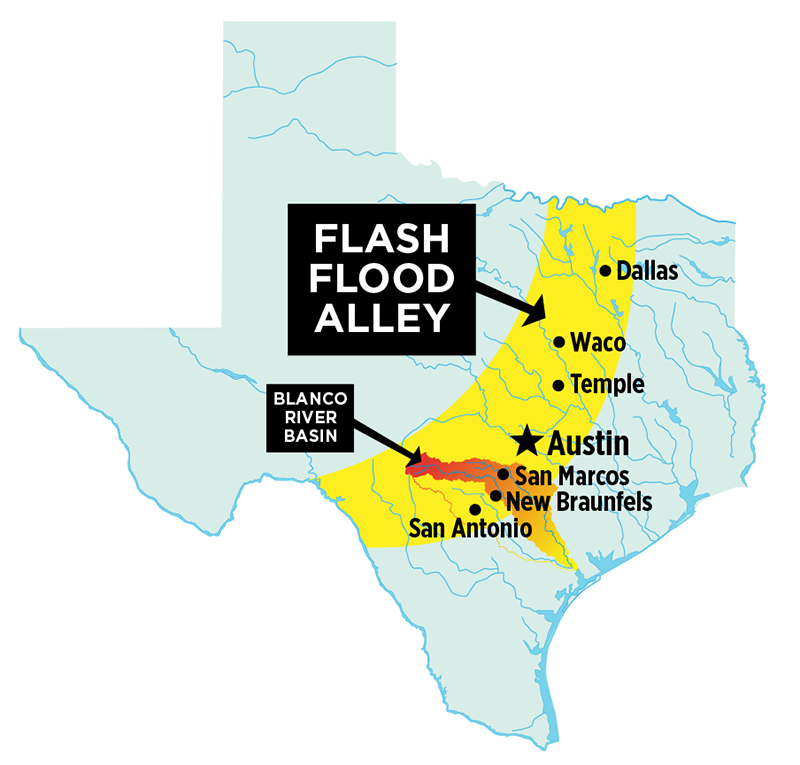
Central Texans are no strangers to floods, especially flash floods. In fact, according to the LCRA, the Hill Country and Central Texas region has even earned the nickname Flash Flood Alley due to a “greater risk of flash flooding than most regions of the United States.” In fact, according to the USGS, Texas has more than double the flood fatalities (since 1960) of any other state.
So what is the cause behind Flash Flood Alley? Floodsafety.com provdes a video graphic overview of the key factors that result in higher flash flood occurence across Central Texas. One key point is the region’s unique geographical location, often positioned at the meeting point of air masses converging from the Gulf and the Pacific. The resulting storms tend to generate high rainfall over short periods of time. When lots of rain falls in too short a time to allow for infiltration, flash floods are sure to follow.
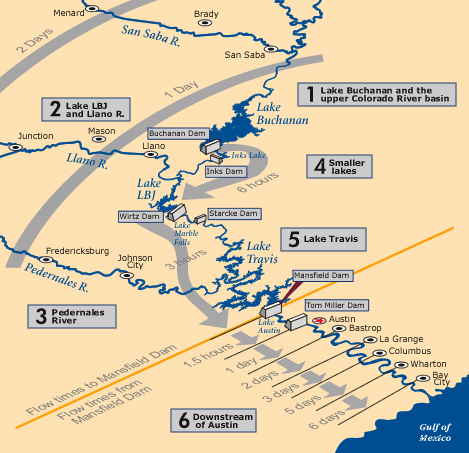 There are several dams in place, controlled by the LCRA, across the six Highland Lakes to help manage floodwaters from heavy rain in the region and prevent greater disasters in areas downstream. These are detailed in the graphic at left (LCRA), showing their progression toward the Gulf of Mexico. Hydrologists at the LCRA River Operations Control Center (ROCC) monitor these sites at all hours and manipulate the dam floodgates.
A year ago in May 2015, Wimberley and Houston experienced deadly floods. Last month, Houston had another. Brian K Sullivan of Bloomberg News explains that “Events like these are often called ‘100-year floods,’ but that can be misleading. The U.S. governments began using the term in the 1960s to describe a flood that has a 1 percent chance of happening in any given year, not a chance of happening only once a century.”
We should note that predictions of historic floods don’t necessarily account for other conditions that can alter the potential for an occurrence, for example climate change or an unusually strong El Niño or La Niña. “That’s why the 100-year event is such a moving target, especially in an urban environment,” said Chuck Watson, director of research and development at Enki Research, which develops tools to measure hazards. “Someone builds a couple of parking lots, and you just turned a 100-year event into a 70-year event because of the impervious surfaces… Asphalt doesn’t soak up rainwater; it just sends it somewhere else, such as into the house next door. When you add in natural climate cycles, the results are further skewed...One of the influences of El Niño is to send more rain across the southern U.S. In a situation like that, the chances of a catastrophic flood might rise to one in 20 according to Chuck Watson.” For more information on 100-year floods and how they’re defined, check out this article from the USGS.
With flooding common in periods of heavy rain, folks in Central Texas should live by these simple, but critical, rules to stay safer:
- Don’t drive over flooded roads or low water crossings; “turn around, don’t drown.” If you need to drive during rainy or flooded conditions, use ATXfloods.com for current updates to help you plan a route around dangerous areas
- If you find yourself stuck in a structure, or on high ground, during extreme flood conditions, do not try to swim for it. Stay where you are as long as possible to allow rescuers the opportunity to come to you
Take a look at this video, shared on Facebook by Robert Teague, of flash flooding in action. As you can see, a massive pulse of water is followed by a buildup of debris proceeding like a tiny monsoon over a low-water crossing. Needless to say, this type of flow is extremely dangerous.
Thursday, May 5, 2016
Aquifer Status
No Drought
Lovelady well height: 532.22 ft-msl (121.20 ft-Depth to Water)
Barton Springs: approximately 110 cfs 10-day average
The graph shows the groundwater
level elevation at the Lovelady monitor well from 1991 to the present. The
Lovelady well is one of the District’s drought index wells (in addition to flow
at Barton Springs). The graph illustrates that over the past two decades there
have been dramatic peaks and critical lows. Due to the recent wetter-than
normal rainfall in the region, the groundwater-level elevation in the Lovelady
well has reached 531.8 ft-msl. This elevation is well above the average of 491.7
ft-msl. The current levels are similar to peak measurements taken at Lovelady
11 years ago in May of 2005 (531.5 ft-msl), and higher than levels reached in
2007 (the 3rd wettest year on record for the region). Barton Springs is also
flowing at very high rates of greater than100 cubic feet per second (cfs), also
above it’s average levels of ~53 cfs.

Climatologists attribute the wet
conditions to a surprisingly strong El Niño phenomenon in 2015-16, which has
already delivered 11 inches of rainfall this year—in addition to the high
rainfall in 2015. Only time will tell if the stronger phenomenon this year will
continue the trend of increasing Lovelady measurements beyond 2005 levels.
All this is good news for the
aquifer as we enter into our normal hot and dry summer period. Conditions are
high enough that we won’t likely approach significant drought conditions in
2016. However, after the creeks stop flowing, we know water levels will begin
their usual decline.
Wednesday, April 6, 2016
April 2016 Edwards & Trinity Aquifers Update
No Drought
Lovelady well height: 529.55 ft-msl (123.87 ft-Depth to Water)
Barton Springs: approximately 103 cfs 10-day average
The effects of
increased rainfall through much of the past year (52 in since last April) have
been evidenced by increased water levels in the Edwards and Trinity Aquifers.
The graphic below depicts the rise in water level in the BSEACD Lovelady
monitor well since May of 2015. The steady rise in water levels since November
2015 almost came to an end at the beginning of March 2016 when 3 inches of rain
over a four-day period brought more recharge to the Edwards Aquifer. This additional
rainfall caused flow in the creeks that pass over the recharge zone to
increase, thereby increasing recharge to the aquifer. And, water levels in
Lovelady are rising again, but slowly.
Notably, water
levels at the Lovelady well are currently at their highest mark since 2007 when
a depth to water of 126.1 ft was recorded.

As an indicator of
recharge to the Trinity Aquifer, Jacob’s Well Spring has benefitted from the
wet 2015 and has maintained flow greater than 10 cubic feet per second (cfs)
through the beginning of 2016 but flow, similar to other streams and springs,
is now beginning to recede.
In the long term,
the presently-strong El Niño has begun visibly weakening, according to NOAA. This weakening could lead to
decreased rainfall, decreased stream flow, and decreased groundwater levels.
That said, the April rainfall total is already a quarter of an inch (0.27 in) five
days into the month and meteorologists predict
more rain to come.
Subscribe to:
Comments (Atom)

