Tuesday, December 12, 2017

La Nina Climate Impacts and Outlook for Texas in 2018

In addition to November’s blog post on  weak La Nina conditions developing in the tropical Pacific, below are some climate forecasts from the Climate Assessment for the Southwest (CLIMAS) team on La Nina’s potential impacts on Central and South Texas. As of early-November, the tropical Pacific and atmosphere were exhibiting weak La Nina conditions. Forecasts favor above-average temperatures and below-average precipitation through approximately February-April 2018.


Drought
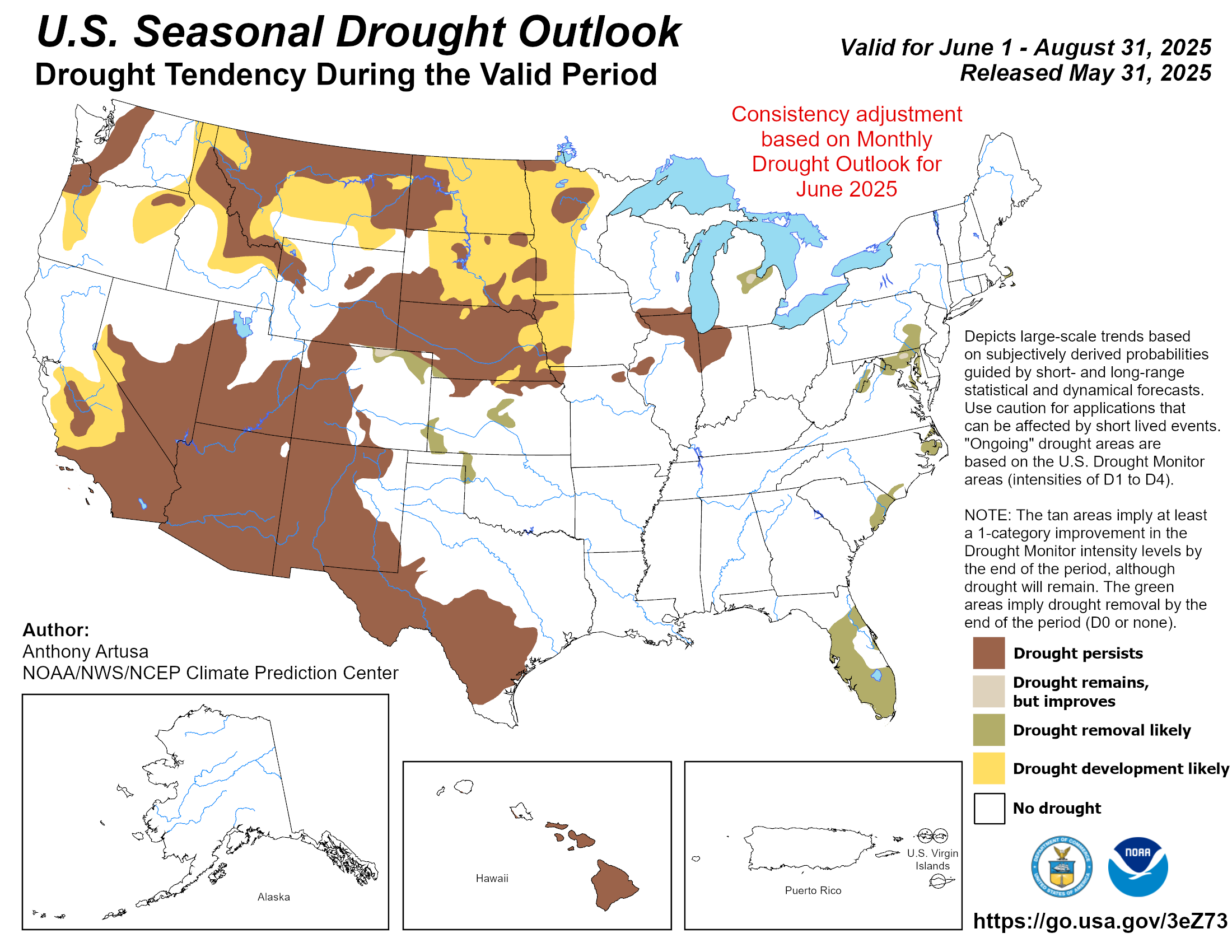
Abnormally dry conditions developed in areas of Central and western Texas between August and October while moderate drought conditions remained in southern Texas. Drought conditions in these areas are predicted to persist through February, according to the U.S. Seasonal Drought Outlook.


Temperature
The three-month NOAA temperature outlook (December-February)
favors chances for above-average temperatures for all of Texas through February.


Precipitation
The NOAA three-month precipitation outlook predicts chances for below-average
precipitation for all Texas, except for the northernmost point of the
state (December-February). La Niña conditions tend to lead to below-average
precipitation in the Southwest U.S. and northern Mexico.


Fire
According to the National Interagency Fire Center (NIFC), fire risk is normal for
New Mexico and Texas through December (Figure 9).
However, La Niña conditions, projected to continue through the winter, are
predicted to bring dry and warm conditions to the Southern Plains, including
Central Texas, by January, making grasses and brush
more receptive to fire.

For More visit here

Monday, December 11, 2017

Texas Cities Using 21% Less Water (than we were in 2000!)


No Drought
Lovelady well height: 507.1 ft-msl (146.3 ft-Depth to Water)
Barton Springs: approxamately 62 cfs 10-day average

Texas Living Waters Project reports that Texans are using 21% less water in our homes than we were back in 2000! Read on.... http://texaslivingwaters.org/texas-good-story-water-conser…/


Wednesday, November 8, 2017

Move over El Nino, La Nina may be on the way

No Drought
Lovelady well height: 516.3 ft-msl (137.2 ft-Depth to Water)
Barton Springs: approxamately 75 cfs 10-day average

Forecasts from the National Oceanic and Atmospheric Administration (NOAA) indicate that a La Nina may make an appearance (55-65% chance) this fall and winter.

La Nina is the opposite of El Nino, a cooling of the equatorial east-central Pacific Ocean. If La Nina does develop, the strength of it (weak, moderate or strong) will determine what impacts it may have on the weather this fall and winter. Typically, the southern tier of the U.S. sees drier than average conditions and temperatures that are above average, while much of the Pacific Northwest and Ohio Valley are wetter than normal and see below average temperatures.(Weather Channel).


What does this mean for Central Texas?
As the La Nina effects suggest, "the latest outlooks for this fall and winter call for rainfall to average near to slightly below normal across our area. Along with that, temperatures should be a little bit milder than normal from October all the way through the end of winter." -Bob Rose, LCRA Chief Meteorologist

Monday, October 9, 2017

High and Dry: New Book Examines World's Biggest Groundwater Challenges

Through captivating stories and thoughtful prose, William and Rosemarie Alley take readers on a journey to better understand groundwater in their new book, “High and Dry: Meeting the World’s Growing Dependence on Groundwater.”


Tuesday, September 5, 2017

Hurricane Harvey and Central Texas

Hurricane Harvey and Central Texas

Hurricane Harvey made landfall on the Texas Gulf Coast late Friday, bringing with it one of the most disastrous floods in the state’s history. From Corpus Christi and Rockport to Houston and La Grange, wind and rainfall from the storm caused damage and displacement on a catastrophic scale. Houston alone received over 51” as of August 31st. That’s the greatest amount ever recorded in the Lower 48 states from a single storm.

The effects of Harvey have extended to Central Texas. Specifically, regarding rainfall:
  • Buda saw 11.7” according to LCRA Hydromet
  • Manchaca received 9.6” according to BSEACD gauges
  • Driftwood recorded 7.4” according to LCRA Hydromet
  • Austin (Mabry: 5.9”, ABIA: 6.2”) got roughly 6” (KXAN weather diary)
  • Wimberley took 5.3” according to LCRA Hydromet

While rain was nearly constant in the region beginning Friday evening and continuing into early Monday, the effects on the stage level of local creeks and rivers might seem unexpectedly subtle. Although all saw a rise in stage and flow, none achieved flood status as a result of the downpour.

Creek/River
Top Stage Level Reached 8/27/17
(ft)
Historic (H)/Flood (F) Stage Level
(ft)
2015 Memorial Day Flood Stage Level
(ft)
Blanco River at Wimberley
3.8
13 (F)
45
Onion Creek at Driftwood
2.7
5.5 (F)
26
Onion Creek at Twin Creeks Rd
12
22 (H)
32
Williamson Creek at Manchaca Rd
7.2
21 (H)
12
Barton Creek above Barton Springs
7.5
18 (H)
18

Springflow at Barton Springs
saw a slight increase of five cubic feet per second (cfs) while Jacob’s Well Spring measured a 40 cfs increase.
 

Water levels in the Barton Springs Edwards Aquifer Conservation District
(BSEACD) Lovelady monitor well were declining until the rain event brought stabilization. 

Onion Creek at Driftwood saw a quick climb to around 210 cfs late Sunday (8/27) night, though the peak was short-lived and never reached flood stage status.


The LCRA reports rainfall totals near the Highland Lakes ranged from less than an inch near Lake Buchanan to widespread totals of 2-4 inches near Lake Travis. This was not enough rain to make a significant difference in lake levels.
As Harvey drifted back toward the gulf late Sunday, rainfall decreased and stage levels began to quickly decline. After the deluge, the area received 9 inches in August, 7 inches above the average for the month.

Friday, July 14, 2017

Texas Well Ownder Network (TWON) Workshop!

Lovelady well height: 534.9 ft-msl (118.5 ft- Depth to Water)
Barton Springs: approxamately 95 cfs 10-day average

Texas AgriLife and the Cypress Creek Project are hosting "Well Educated" on Thursday, July 27, 2017, 8:30am – 3:30pm at the Wimberley Community Center. They will go over well maintenance, water quality, treatment, and test a well water sample for FREE! Great training opportunity!

http://www.cypresscreekproject.net/calendar-1/2017/6/27/texas-well-owner-network-twon-workshop


Thursday, May 25, 2017

This Weekend is Tax Free Weekend...Water Efficient Products!

Happy Memorial Day weekend!
You can buy certain water-efficient and water-conserving products tax free during the Water-Efficient Products Sales Tax Holiday—THIS WEEKEND. There is no limit on the number of qualifying items you can buy.

The 2017 holiday begins Saturday, May 27, and goes through Monday, May 29 (Memorial Day).

Examples of tax free purchases:
·         Showerheads, toilets, faucets
·         Soaker hoses, mulch, soil, compost
·         Rain barrels, alternative rain and moisture collection system
·         Plants, trees, grasses


Thursday, May 4, 2017

Beginning of Water Conservation Period

The District’s Water Conservation Period starts Monday, May 1st and extends through the end of September— the time when water use is at its peak.

Since January 2016, groundwater levels in the District have been above drought thresholds.  Recent wet weather has helped augment water supplies, but there is still a need to conserve water resources.  The last drought proved that surface water and groundwater resources are precious and limited.  Water conservation through the summer months can help us delay and/or avoid another drought situation.

Starting on May 1st, Austin Water Utility restricts outdoor watering to no more than twice per week, and the Barton Springs/Edwards Aquifer Conservation District initiates a voluntary 10% reduction in groundwater pumping by its permittees.  Though the approaches are different, the goal is the same—prolong water availability throughout the hottest and driest portion of the year.

John Dupnik, Aquifer District General Manager notes, “Through being mindful of smart water use during the hot summer months, a little effort by individual end-users, when multiplied across central Texas, can do a great amount of good.”

“Our groundwater users are traditionally very conscious of water use.  Simple leak fixes and water conservation choices can add up to make a big difference in extending our long-term water supply,” states Robin Gary, Senior Public Information and Education Coordinator.


Water conservation strategies, rainwater harvesting information, water-wise landscaping ideas, and self irrigation audit guidance is available at www.bseacd.org/education/water-conservation/. 

Wednesday, May 3, 2017

BSEACD Scientific Presentations

Lovelady well height: 541.43 ft-msl (112.39 ft- Depth to Water)
Barton Springs: approxamately 108 cfs 10-day average

District staff have made several presentations at conferences such as the South Central Geological Society Annual Meeting and the Gulf Coast Geological Society Annual Meeting.  These meetings allow for increased dialog that helps vet and extend research. 


The published abstracts, papers, and several of the presentations are available online:


Friday, April 14, 2017

April 19: Free Well Water Checkup

This year's Well Water Checkup and Ask-An-Expert Open House will be on Wednesday, April 19, 2017.  Screening is available to the first 75 well owners in the District to come in, pre-register and pick up sampling supplies and instructions.  Sample supplies must be picked up by Tuesday, April 18. There are about 30 slots still available.  Come in to get supplies!
 

The USEPA recommends that private water wells should be tested annually for contaminants that can jeopardize the health of its users, especially vulnerable populations like children, the elderly, or those with compromised immune systems.  Samples from private water wells will be screened for common contaminants, including fecal coliform bacteria, nitrates, and salinity. 

You'll be able to bring in your water sample for analysis on April 19; if you come between 11-1 you can talk with a well servicer, septic system expert, water quality expert, water quality lab manager, and District staff while you wait for your results.